


When one individual becomes the system, the structure and the process, the organisation may be more vulnerable than it looks.
Does your organisation suffer from Oga Syndrome?
You will not find it in any management textbook. You will almost certainly recognise the symptoms.
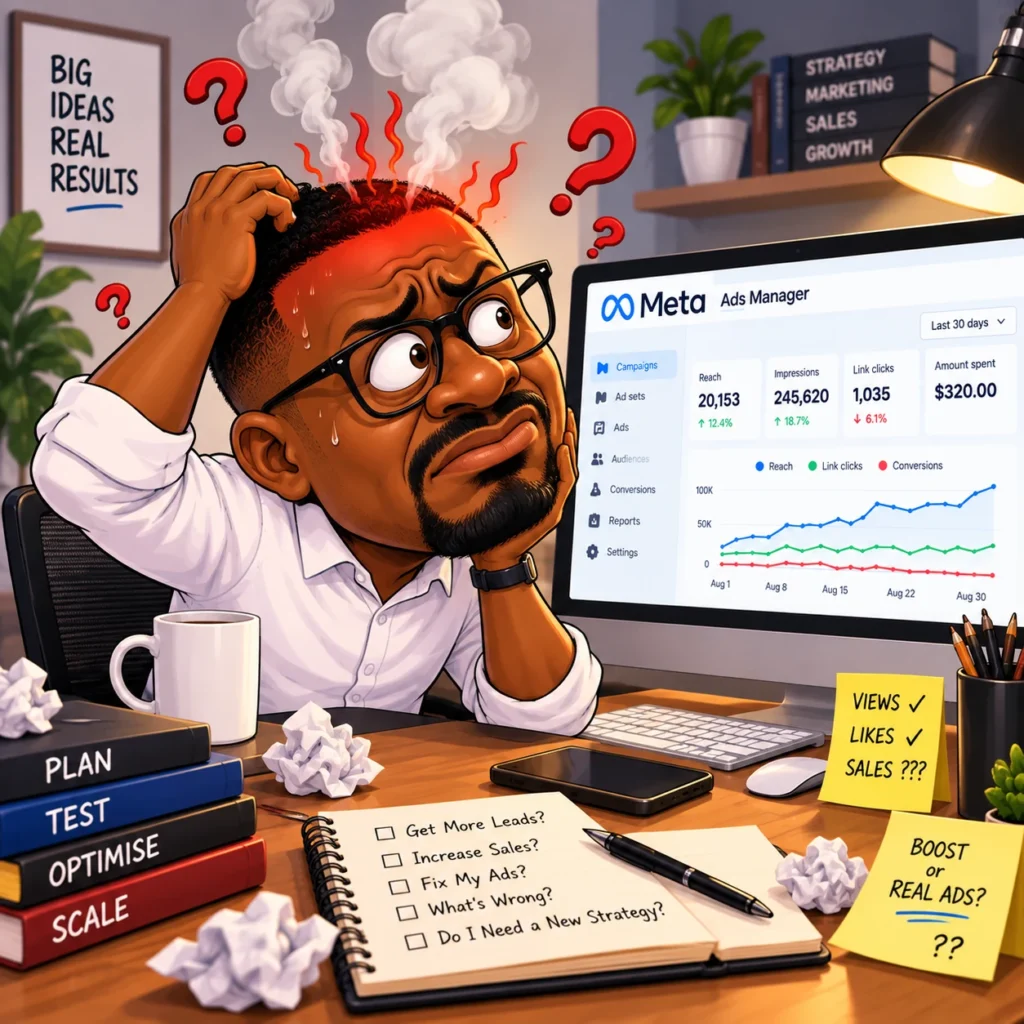
You boost a post and the numbers look great, but the problem soon becomes obvious, the views are increasing, the likes are coming in, yet the enquiries, leads and sales aren’t. So why are 20,000 people seeing your business without becoming customers? Because reaching more people doesn’t automatically increase your chances of conversion.
There is a reason a three-legged stool works.
It does not need a fourth leg that would be a chair. It does not need one leg stronger than the others. It simply needs all three legs to be strong, properly positioned, and working together. Shorten one leg and the stool tilts. Weaken another and it becomes unreliable. Remove one completely and you no longer have a stool at all. You have a balancing act.
The Biggest Waste in your businesses’ Digital Transformation journey is buying technology your people can’t use properly.
Nigerian businesses are spending more on technology than ever: AI subscriptions, CRMs, automation tools, analytics platforms and expensive enterprise software. Yet months later, many are still dealing with the same slow processes, the same productivity problems and the same employees doing things the same old way.

Does your organisation suffer from Oga Syndrome? You will not find it in any management textbook, but you will recognise the symptoms: “Oga knows everybody.” “Madam has to approve it first.” “There’s no need to document it; he knows how everything works.” At first, these may sound like signs of strong leadership. But there is a major difference between an organisation benefiting from an exceptional individual and becoming dependent on one. At aCubed, we call the latter Oga Syndrome: when individual capability substitutes for institutional capability. The CEO becomes the system, the Founder becomes the structure, the HOD becomes the process, and everyone else waits for Oga. Risk professionals call this key person risk or a single point of failure, while management thinkers recognise similar characteristics in the Founder’s Trap. Even the Central Bank of Nigeria requires succession planning in systemically important banks to minimise disruption from abrupt leadership changes. If major financial institutions prepare for the sudden absence of key leaders, every serious organisation should ask the same question.
The danger is measurable. Research examining nearly 1,500 entrepreneur deaths found large and persistent declines in company performance following the loss of an entrepreneur, with larger startups experiencing an average sales impact of about 60%, while sales and assets were roughly 50% lower than comparable unaffected businesses. Death is an extreme example, but the management question is simpler: how much of your organisation’s value lives inside one human being? Relationships, knowledge, authority, client confidence, technical expertise, approvals and institutional memory should not all reside with one person. If your business development strategy is simply “our boss knows everybody,” you may not have a business development strategy; you have a boss with contacts. Strong organisations convert personal relationships and knowledge into institutional assets. Oga does not even have to be the founder—it could be the CEO, Chairman, Finance Director, Head of Operations, IT Manager or the administrator without whom something important simply cannot happen. Barings Bank’s 1995 collapse, following approximately £827 million in losses linked to trader Nick Leeson, dramatically demonstrated why systems, segregation of duties, oversight and controls must remain stronger than any individual, regardless of how talented or successful that person appears.
Succession, therefore, is not merely an HR issue; it is about resilience. The question is: if Person A becomes unavailable tomorrow, can Responsibility A continue? Deloitte’s 2026 study of 1,587 family businesses across 35 countries found that although 82% had some form of succession plan, only 46% described those plans as broad and well developed, while 32% identified leaders’ reluctance to relinquish control as a significant obstacle. Sometimes the problem is not that nobody can replace Oga; it is that Oga has never allowed anyone to become capable of doing so. Disney experienced another version of this after Walt Disney’s death, when “What would Walt do?” reportedly became a recurring question. The lesson is simple: the greatest legacy of a leader is not an organisation that constantly asks what they would have done, but one that has learned how to think and operate without them. A practical test is whether Oga can take a real holiday—without emergency approvals, constant WhatsApp messages or decisions being postponed until they return.
That is why aCubed emphasises Systems, Structures and Processes (SSP). Systems preserve knowledge, structures distribute authority and responsibility, and processes make successful execution repeatable. To test your organisation, imagine a critical leader disappears for 90 days with no calls, WhatsApp, emails or quick approvals. Ask what decisions would stop, which deals and relationships would become vulnerable, what data and knowledge would become inaccessible, which areas of delivery would fail, and how often people would still say, “We need to ask Oga.” You do not need a sophisticated scoring system; the answers reveal your dependency. Great people should strengthen organisations, not substitute for them. There is a fundamental difference between “we have an exceptional CEO” and “nothing works without our CEO.” So every Board, founder and senior executive should occasionally ask: If I disappeared for 90 days, what would stop working? If the answer is “very little,” you may have built an institution. If the answer is “almost everything,” you may have a serious case of The Oga Syndrome.
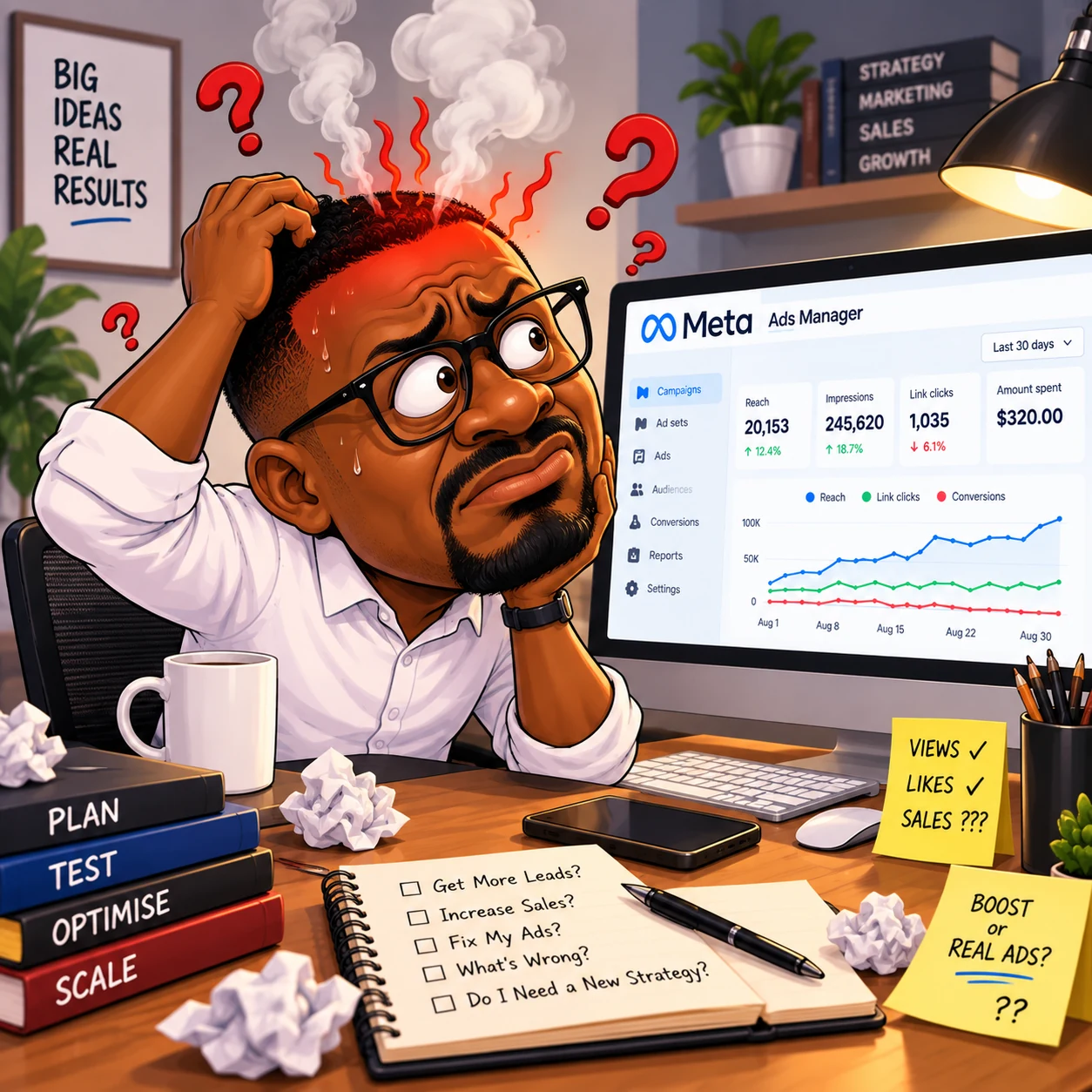
You boost a post and the numbers look great.
The views are increasing, the likes are coming in, the reach is reaching and Yet the enquiries, leads and sales aren’t.So why can 20,000 people see your business without becoming customers? Because reach is not intent, and visibility does not automatically translate into conversion.
In digital advertising, who Meta is optimising to reach, and what it is optimising them to do, matters.Meta itself uses what it calls an “estimated action rate” as part of its advertising auction. Put simply, its systems estimate how likely a particular person is to take the action an advertiser wants, whether that is visiting a website, engaging with content, submitting a lead or making a purchase.
That distinction is important.
Boosting a post is advertising. But it is a simplified form of advertising, with fewer campaign, optimisation, testing and measurement controls than those available through Meta Ads Manager. So, if your real objective is to generate measurable business outcomes such as leads, enquiries or purchases, simply reaching more people may not be enough. Your campaign needs to be deliberately built around the action you actually want people to take.
This is the part of Meta advertising many businesses never really get to experience.People behave differently online.Some people are more likely to watch videos. Some regularly like, share and comment on posts. Others are more likely to visit websites, complete forms, make enquiries or purchase products.
Meta uses a wide range of signals and machine learning to predict these behaviours and determine how ads are delivered.So, if you’re getting plenty of views and likes but very few enquiries, it doesn’t necessarily mean Meta isn’t working. It may be doing exactly what you’ve asked it to do. The problem may simply be that the result you’re optimising for isn’t the result your business actually needs. This becomes even more important when you want people to leave Facebook, Instagram, WhatsApp or other Meta placements and take action on your website.
At that point, reach and clicks alone don’t tell you enough. Did the landing page actually load? Did the visitor submit the form? Did they make a purchase? Which advertisement generated the conversion? And most importantly, how much did that result actually cost you? This is where tools such as the Meta Pixel and Conversions API become important. When properly implemented, these tools help businesses measure relevant actions happening on their websites and send those signals back to Meta for measurement and optimisation.
Instead of simply saying:
“Show this content to more people.” you are increasingly giving the advertising system information about the actions that actually matter to your business. And that is also why businesses need to be careful with vanity metrics.100,000 impressions can look fantastic in a report. But if the objective was to generate leads, the more important questions are:
How many leads did we generate?
What did each lead cost?
How many of those leads were actually useful?
And ultimately, did those leads contribute to revenue?
Meta itself distinguishes impressions from the wider business outcomes advertisers may be trying to achieve, including purchases, sign ups and other actions. The metric should always follow the business objective. Of course, someone can see a boosted post today and eventually become a customer. Advertising is rarely as neat or linear as we would like it to be.
But a conversion happening is not the same as deliberately building a campaign that is designed, measured and optimised to generate conversions consistently. Proper campaign management goes beyond pressing “Boost”.
It means choosing the right campaign objective and performance goal.
It means setting up tracking correctly.
It means knowing which metrics actually matter.
It means testing your creatives, messages, audiences and placements.
And it means continuously using the data to improve performance.
Sometimes that data may even tell you that the advertising isn’t the problem. People may be clicking but abandoning your landing page. You may be generating leads, but they’re poor quality leads. Your advert may be attracting attention without attracting buyers. Your landing page may be slow or confusing. Your offer may simply not be strong enough.
Without proper measurement, you don’t know and if you don’t know, the easiest response is often to spend more money boosting more content. That may simply produce more of the wrong result.
So if you’re spending money every month, getting impressive reach, views and likes but struggling to connect that activity to enquiries, leads or sales, boosting more posts isn’t necessarily the answer. You need to start treating digital advertising as a measurable system built around the outcome your business actually wants. And if you don’t have the technical knowledge to set that up, track it and manage it properly, hire a professional who does.
Because paying Meta to show your content to more people and deliberately using Meta advertising to produce a measurable business outcome are two very different things.

There is a reason a three-legged stool works: all three legs must be strong, properly positioned and working together. Shorten one and the stool tilts; weaken another and it becomes unreliable; remove one and you have a balancing act. Organisations are no different. Beneath strategy, leadership, innovation, technology, people and growth sit three fundamentals: **Systems. Structures. Processes.** Organisational stability depends not merely on having all three, but on keeping them aligned.
Systems are infrastructure. Structures create accountability. Processes enable execution. Systems technology, financial, reporting, customer management, performance and information systems create institutional memory and allow organisations to operate beyond what sits in one person’s head. But even the best ERP, CRM or analytics platform cannot compensate for poor structure or broken processes; digitising confusion simply makes the confusion faster. Structure determines responsibility, accountability, authority, reporting lines, delegation and decision rights. Without it, decisions unnecessarily travel upwards, responsibilities overlap and everything eventually lands on one executive’s desk. Processes, meanwhile, determine how work actually gets done from approving payments and resolving complaints to onboarding employees and implementing ideas. Good processes make execution repeatable without turning the organisation into a bureaucracy.
The real problem, however, is often not a missing leg but unequal legs. An organisation may have sophisticated technology while approvals remain manual; restructure departments while processes still reflect the old organisation; introduce new processes without establishing ownership; or grow significantly while decision-making authority remains where it was when the company was much smaller.
A business may demand agility while maintaining seven approval layers, demand accountability without clear ownership, or invest in automation while continuing parallel manual processes “just in case.” All three legs exist, but they are out of sync and the stool still wobbles.
That is why organisational improvement cannot happen in isolation. Change a system and ask which structures and processes must change with it. Change the structure and ask which systems and processes need redesigning. Change a process and establish who owns it, who has authority and what system supports it.
Systems without Structure create tools without accountability. Structure without Processes creates hierarchy without execution. Processes without Systems create effort without scalability.** The question for leadership teams, therefore, is not simply, *“Do we have the right Systems, Structures and Processes?”* It is: **“Are all three actually in sync?”** Because a three-legged stool does not negotiate with imbalance. Neither, eventually, does an organisation.

The biggest waste in a digital transformation journey isn’t the money spent on technology. It’s buying technology your people are never taught to use.
Nigerian businesses are spending more on technology than ever. AI subscriptions, CRMs, automation tools, analytics platforms, expensive enterprise software. Yet months later, many are still dealing with the same slow processes, the same productivity problems, and the same employees doing things the same old way.
The technology changed. The organisation didn’t.
We tend to assume that acquiring better technology automatically creates a better organisation. It doesn’t.
Technology is an enabler, and its value depends almost entirely on the capability of the people using it. Give two employees access to the same AI tool and you can get two completely different outcomes. One uses it occasionally to rewrite emails. The other uses it for research, analysis, reporting, ideation and repetitive workflows saving several hours of work every week. Same subscription. Completely different return on investment.
And this problem isn’t limited to AI.
A company can spend millions implementing a CRM, but if employees don’t understand why customer information needs to be captured properly, you end up with an expensive database nobody trusts. You can introduce a new project management platform, but if teams keep coordinating through scattered WhatsApp messages, emails and phone calls, you’ve added another subscription without changing how work actually gets done. You can purchase sophisticated analytics software and still make decisions based on assumptions, if the people receiving the data were never taught how to interpret it.
The technology isn’t necessarily failing. The implementation is. This is a well-documented pattern, not a Nigerian one. McKinsey’s global survey of digital transformations found that only 16 percent of organisations reported both improved performance and the capability to sustain that improvement over time. The tools were rarely the constraint. The gap was almost always in how the organisation absorbed them.
Budgeting for Half a Transformation.
If you’re budgeting ₦10 million for a new system but almost nothing for training, adoption and process redesign, you’re only budgeting for part of the transformation. Installing software is relatively easy. Changing how people work is harder. Employees need to understand not just how to operate a new tool, but why it’s being introduced, where it fits into their existing responsibilities, and how it should change the way they work. This is particularly true of AI.
Buying AI Is Not the Same as Becoming AI-Enabled
Giving employees access to ChatGPT, Copilot or another AI platform doesn’t automatically make a company AI-enabled. If they don’t know how to identify useful applications, give AI the right context, evaluate its outputs, protect sensitive information and fold it into real workflows, the organisation may be paying for powerful technology being used at a fraction of its potential.
This is where the numbers get uncomfortable. A 2025 BCG study of more than 1,250 companies globally found that only 5 percent had reached the maturity to extract substantial, sustained value from their AI investment; 60 percent were seeing next to nothing despite significant spend. The single biggest differentiator between the two groups wasn’t the tools they’d bought, it was whether they’d deliberately built the talent and skills to use them. That’s exactly where corporate training needs to go beyond simply showing people which buttons to click.
Training Should Change Behaviour, Not Just Familiarity
Good technology training should leave people thinking differently about their own work, not just aware of what the software can technically do.
A finance team should be rethinking its workflows. Marketing should be finding new efficiencies. Operations should be identifying repetitive tasks worth automating. Managers should understand where automation makes sense and, just as importantly, where human judgement still has to lead. Otherwise, six months later, management starts asking why the expensive new technology hasn’t moved productivity at all.
The Uncomfortable Answer
The answer, when it comes, is rarely about the software. You upgraded the tools. You didn’t upgrade the capability of the people using them. The businesses that benefit most from this wave of AI and digital transformation won’t necessarily be the ones with the biggest technology budgets. They’ll be the ones that understood, early, that every serious technology investment has a human side. Because ultimately, technology doesn’t transform organisations. People using technology effectively do.